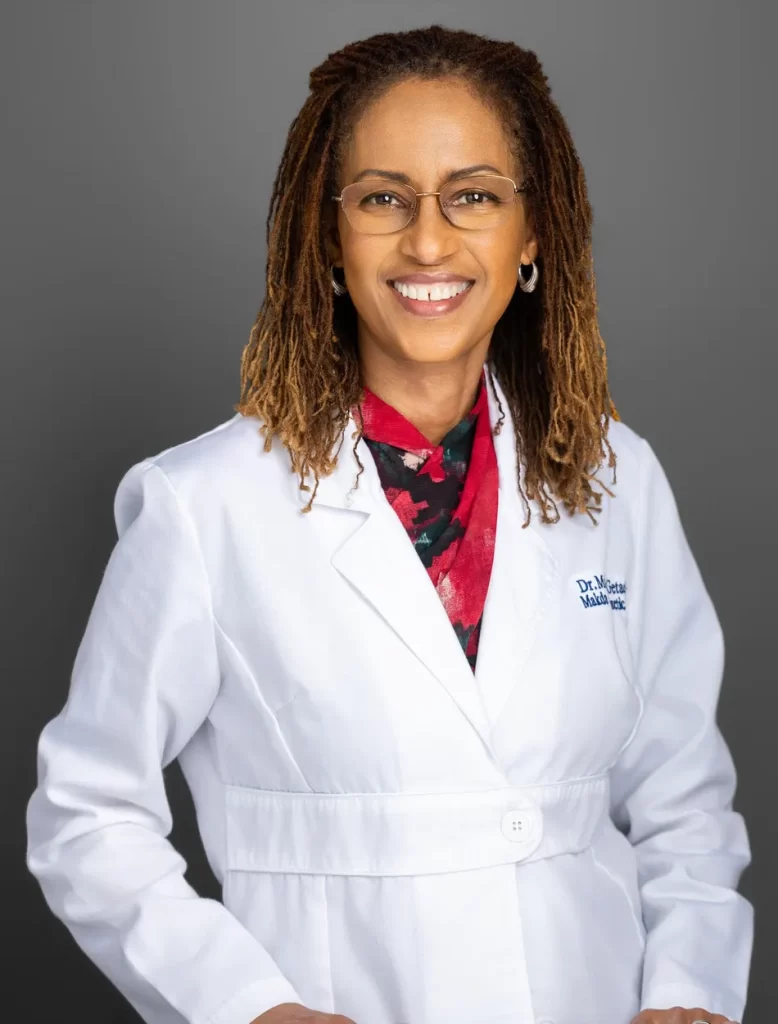

Makda Getachew, DC
Chiropractic Physician
Director – Alexandria Spine and Injury Center
Director – Disc Center of America, Alexandria
Dr. Getachew has been assisting the Washington Metropolitan Area residents, and their families in achieving wellness goals through professional chiropractic care, physical medicine and injury rehabilitation for the past 25 years.
Dr. Getachew is committed to her patients and focuses her talents, educational background and personal attention to each patient to ensure our clinic provides the highest standard of professional services.
Dr. Getachew conducted her Undergraduate Studies at the University of Maryland. She received her Batchelor’s and Doctor of Chiropractic Degree at Logan University.
Dr. Getachew developed a special interest in treating the most severe cases of neck pain, back pain, and sciatica. She has spent many post graduate hours in specialized treatment of herniated, bulging, and degenerative discs. She has also spent countless hours learning and seeking the best non- surgical treatment protocols for these conditions.
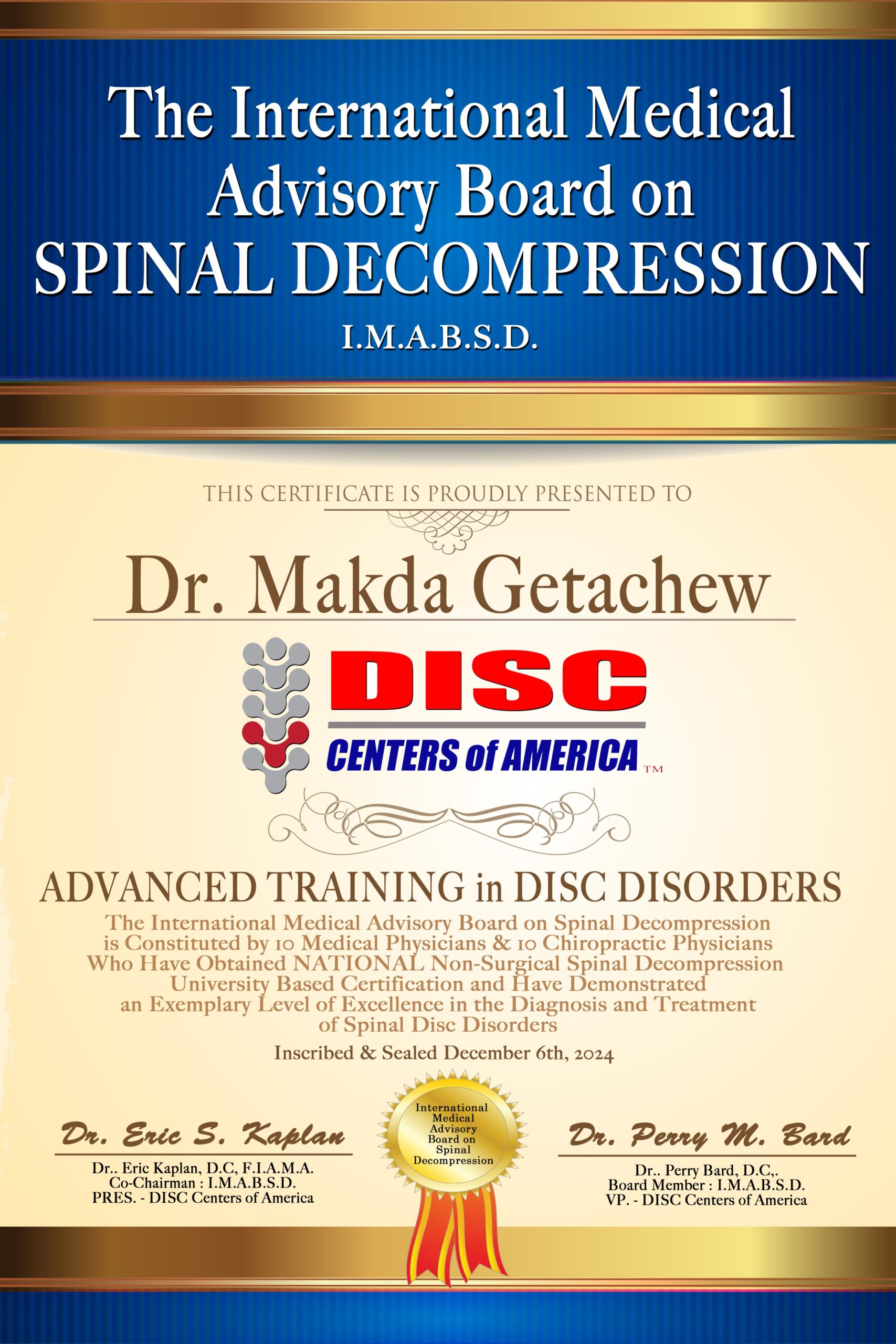
Dr. Getachew is currently the only female doctor to be nationally certified in non-surgical spinal decompression in the Northern Virginia area. This unique certification program has been approved by the International Medical Advisory Board for Spinal Decompression and is the first decompression program of it’s kind to be offered in America.
Dr. Getachew is now a member of a nationwide group of practitioners called Disc Centers of America. The protocols and research of these centers includes the most state of the art treatment plans with the highest success rates that Dr. Getachew could
find available to date. She is now the official office for this specialized treatment protocol in Alexandria, VA.
Disc Centers of America doctors offer Non-Surgical Spinal Decompression, which is a conservative approach to disc restoration, maintenance, and support through IDD Therapy, exclusive to Disc Centers of America. IDD , Intervertebral Differential Dynamics Therapy relatively new category of treatment for back problems known as “nonsurgical spinal decompression” which, in very general terms is a treatment delivered by a motorized machine, controlled by a computer, that applies a variable distraction/traction force to the spine.
For patients with a history of back pain who are currently experiencing symptoms that are interfering with activities, the first step is proper diagnostic testing to determine the cause of the symptoms and the severity of the problem. Then once the source of the pain is determined to be disc related, IDD Therapy, a form of decompression therapy along, modalities and exercise protocols will help the patient restore their health.
She has extensive training and is expert on treatment and documentation of injuries resulting from motor vehicle accidents. Additionally, she combines physiotherapy, rehabilitation techniques in addition to chiropractic adjustments.
Dr. Getachew is a certified Chiropractic BioPhysics® practitioner. She is trained to correct abnormal spinal structures, that are the cause of pressures on the disc and joints, helping hundreds of patients avoid surgery and achieve amazing results through natural methods.
In her spare time Dr. Getachew enjoys gardening and spending time with her family.
Dr. Getachew’s Certifications Include:
Advanced Training in Disc Disorders
MRI spine interpretation
Whiplash and Brain Injury Traumatology
Certified Chiropractic Sports Physician
Certified Chiropractic BopPhysics
Dry Needling Certification
Dr. Getachew is a member of Virginia Chiropractic Association
Makda Getachew, DC
5254 Dawes Avenue Alexandria, VA 22311
Phone + (703) 933 – 3838
703-933-3837 Fax
info@alexandriaspine.com
SELECTED OCCUPATIONAL HISTORY
Clinic Director and Chief Administrator, Makda Chiropractic Health Center, PC Alexandria, VA 2000-present
Chiropractor and Clinic Director, Alexandria, VA 2000-present
EDUCATION and LICENSURE
Doctor of Chiropractic, Licensed in the State of Virginia, License # 0104555769, 2000-present
Internship, Capital Sports Injury Center with Dr. Horwitz who was the sole chiropractor on the sports medicine staff of the 1996 United States Olympic Team
Logan Chiropractic College, Doctor of Chiropractic, St. Louis, Missouri 1999
Logan Chiropractic College, Bachelor of Science, St. Louis, Missouri 1996
University of Maryland, prerequisite courses, College Park, MD 1994
Associates Degree in Banking and Finance 1989
SELECTED POST-GRADUATE EDUCATION, CERTIFICATIONS and DIPLOMATES IDD Therapy
Comprehensive knowledge IDD Therapy by having completed training to Administer and provide the IDD Therapy protocols specifically for spinal pathologies using the Accuspina system device.
North American Medical Corporation, 2025 Advanced training in Disc Disorders –
The international Medical Advisory Board on Spinal Decompression is constituted by 10 Medical Physicians & 10 Chiropractic Physicians who have obtained National Non-Surgical Spinal Decompression University based certification and have demonstrated exemplary level of excellence in the diagnosis and treatment of spinal disc disorders.
Disc Centers of America – 2024 Certified in Chiropractic ByoPhysics –
A certification that focuses on structural rehabilitation of the spine through posture and spinal alignment.
2021 Certified Chiropractic Sports Physician – Post-graduate education in chiropractic sports medicine . American Board of Chiropractic Sport Physicians 2017 Whiplash Advanced Topics – The fundamentals
Requisite and comprehensive biomechanics knowledge for forensic experts Whiplash and brain injuries: the real reasons they are on the rise, the minimal property damage = minimal injury risk myth exposed, In-depth analysis of brain, neck, and cervical spine trauma mechanisms, soft tissue injuries: a comprehensive and cutting edge analysis, all clinical syndromes and conditions resulting from Whiplash (WAD/CAD), forensic experts need to know about the various pain syndromes risk assessment: the fundamental key to modern forensic practice.
Spine research institute of San Diego – 2009 Management Principles in Personal Injury and Forensic Documentation
In-depth training on all aspects of management of trauma, from beginning to end; a comprehensive primer on crash reconstruction. Auto crash reconstruction in low speed crashes: critical knowledge for today’s forensic practitioners, historical documentation in personal injury and forensic medicine applications, comprehensive physical examination of whiplash and traumatic brain injury, special laboratory methods, such as the S-100 protein, the latest techniques, special diagnostic imaging modalities (SPECT, PET, MRI, MRA, VF, etc.); how and when to use, electro diagnostics (EMG, SEMG, SSEP, VEP, ETC…); how to use, rendering a diagnosis/impression in the personal injury or forensic setting; pearls and pitfalls, soft tissue healing times and implications for successful case management. The state of the injury and implications for case management: designing a treatment plan and living with guidelines, important applications of activities of daily living;
optimizing outcomes, chiropractic manipulation, deep tissue massage, and PT Modalities for best outcomes.
Spine research institute of San Diego – 2009 Principles of Impairment Rating and Forensic Reporting
Critical documentation from day 1; What every personal injury and forensic expert needs to know, the fundamental of expository, scientific writing you were never taught; common dos and don’ts, the essential craft of narrative report preparation from A-Z; style, strategy, methods, organization, and common pitfalls, incorporating outcomes assessment and disability instruments into your reports (SCL-90-R, Oswestry, Roland-Morris, Rivermead PCS, and more), the application of AMA guidelines in personal injury and forensic practice, modern guidelines and best practices (Presley Reed, Mercy, QTF, ACOEM, Croft); how they are commonly abused and how and when to use them correctly, critical rebuttal methods and strategies in today’s modern forensic practice, special software applications: managing data, information, graphics; saving time.
Spine research institute of San Diego – 2009 MRI Anatomy & History,
Normal anatomy of axial and sagittal views utilizing T1, T2, 3D Gradient and STIR sequences of imaging. Standardized and desired protocols in views and sequencing of MRI examination to create an accurate diagnosis in MRI.
CMCS Post Doctoral Division, New York Chiropractic Council, New York State Department of Education, Board for Chiropractic, (presenter) AACME Joint Sponsorship with the State University of New York at Buffalo, School of Medicine and Biomedical Sciences and CMCS Post Doctoral Division, Buffalo, NY 2009 MRI Physics and History,
Magnetic fields, T1 and T2 relaxations, nuclear spins, phase encoding, spin echo, T1 and T2 contrast, magnetic properties of metals and the historical perspective of the creation of NMR and MRI.
CMCS Post Doctoral Division, New York Chiropractic Council, New York State Department of Education, Board for Chiropractic, (presenter) AACME Joint Sponsorship with the State University of New York at Buffalo, School of Medicine and Biomedical Sciences and CMCS Post Doctoral Division, Buffalo, NY 2009 MRI Interpretation of Spinal Cord, Spinal Disc and Spinal Canal Disorders,
MRI interpretation of herniated, protruded, extruded, bulged and sequestered discs & spinal stenosis as sequelae of ligamentous hypertrophy, congenital malformation, spinal cord pathology. Clinical necessity and contraindications.
CMCS Post Doctoral Division, New York Chiropractic Council, New York State Department of Education, (presenter) AACME Joint Sponsorship with the State University of New York at Buffalo, School of Medicine and Biomedical Sciences and CMCS Post Doctoral Division, Buffalo, NY 2009 MRI Interpretation Herniated Disc and Spinal Cord and Root Encroachment,
MRI interpretation of herniated, protruded, extruded, bulged and sequestered discs and their relationship to spinal adjustments, manual spinal therapy and joint mobilization.
MRI Clinical Application,
The clinical application of the results of space occupying lesions. Disc and tumor pathology’s and the clinical indications of manual and adjustive therapies in the patient with spinal nerve root and spinal cord insult as sequelae.
CMCS Post Doctoral Division, New York Chiropractic Council, New York State Department of Education, Board for Chiropractic, (presenter) AACME Joint Sponsorship with the State University of New York at Buffalo, School of Medicine and Biomedical Sciences and CMCS Post Doctoral Division, Buffalo, NY 2009 MRI Normal Anatomy & Protocols,
Spinal anatomy of all MRI views utilizing T1, T2, 3D Gradient, stacking and STIR sequences of imaging. Advanced protocols of MRI examination with multiple sequences to create concurrent diagnostic findings.
CMCS Post Doctoral Division, New York Chiropractic Council, New York State Department of Education, Board for Chiropractic, Ronkonkoma, NY, 2009 MRI Disc & Spinal Cord and Spinal Canal Pathology,
MRI interpretation of spinal disc pathologies as a result of trauma and degenerative factors and resultant neurological compromise. Spinal Cord and Spinal canal pathologies and space occupying lesion interpretation.
CMCS Post Doctoral Division, New York Chiropractic Council, New York State Department of Education, Board for Chiropractic, Ronkonkoma, NY, 2009 Crash Dynamics and its Relationship to Causality,
Critical factors in the physics involved in the transference of energy from the bullet car to the target car including G’s of force, Newton’s, gravity, skid marks, crumple zones, spring factors, event data recorders and the graphing of movement of the vehicle before, during and after the crash. Determining the clinical correlation of forces and bodily injury.
CMCS Post Doctoral Division, New York Chiropractic Council, New York State Department of Education, New York, 2008-present Diagnostics, Risk Factors, Clinical Presentation and Triaging of the Trauma
Patient, Clinically coordinating the history and physical findings and when to integrate neurodiagnostics, the utilization of emergency room records in creating an accurate diagnostic impression and the incorporation of risk factors in spinal injury.
CMCS Management Post Doctoral Division, New York Chiropractic Council, New York State Department of Education, New York, 2008-present Documenting Clinically Correlated Bodily Injury to Causality,
Understanding the necessity for accurate documentation, diagnosis and clinical correlation to the injury when reporting injuries in the medical-legal community. Documenting kinesiopathology, myopathology, neuropathology and pathophysiology in both a functional and structural paradig.
CMCS Post Doctoral Division, New York Chiropractic Council, New York State Department of Education, New York, 2008-present Documenting and Reporting for the Trauma Victim,
Understanding the necessity for accurate documentation and diagnosis utilizing the ICD-9 and CTP to accurately describe the injury through diagnosis. Understanding and utilizing state regulations on reimbursement issues pertaining to healthcare.
CMCS Post Doctoral Division, New York Chiropractic Council, New York State Department of Education, New York, 2008-presen MRI, Bone Scan, X-Ray Trauma Protocols, Physiology and Indications for the Trauma Patient,
Spinal MRI interpretation, physiology, history and clinical indications, Bone Scan interpretation, physiology and clinical indications, x-ray clinical indications for the trauma patient.
CMCS Post Doctoral Division, New York Chiropractic Council, New York State Department of Education, New York, 2008-present
Neurodiagnostics, Imaging Protocols and Pathology of Trauma Patient,
Critical protocols in triaging and reporting the clinical findings of the trauma patient. Maintaining ethical relationships with the Medical-Legal community.
CMCS Post Doctoral Division, New York Chiropractic Council, New York State Department of Education, New York, 2008-present
Neurodiagnostics Testing Protocols, Physiology and Indications for the Trauma Patient,
Electromyography (EMG,) Nerve Conduction Velocity (NCV,) Somato Sensory Evoked Potential (SSEP,) Visual Evoked Potential (VEP,) Visual-Electronystamography (V-ENG) interpretation, protocols and clinical indications for the trauma patient.
CMCS Post Doctoral Division, New York Chiropractic Council, New York State Department of Education, New York, 2008-present Chiropractic in the World of sports Injuries
Athletic Patient vs. Non Athletic Patient, the Chiropractic Sports Practice: low profile sports, the sports medicine team, the Chiropractor’s role. Macro vs. Microtrauma: overuse/repetitive motions, viscoelastic properties of tissues, tissue healing phases, Statistical information of injuries. Evaluation of musculoskeletal Injuries: muscle fiber types, grading of sprains/strains, postural evaluation. Common sports related injuries: evaluation and diagnosis on field and office, treatment acute and chronic protocols and supportive taping and bracing. Rehabilitation: cross-over effect, overflow and facilitation.
Palmer College of Chiropractic, Davenport, IA 2008 Diagnostic Testing and Imaging – Protocols and Interpretation, MRI protocols and interpretation,
CAT Scan protocols and interpretation, x-ray trauma series protocols, bone scan protocols and interpretation, EMG/NCV protocols and interpretation and utilization of International Classification of Disease coding in Trauma.
CMCS Post Doctoral Division, New York Chiropractic Council, New York State Department of Education, New York, 2007-present The Nutritional Adjustment
Preventive, alternative and holistic therapy protocols that have proven to be effective in reducing disease, managing injury and shortening recovery periods. Alternative to medication and surgery (natural alternatives to medications and surgery. Natural protocols for prevention of cardiovascular disease, arthritis, osteoporosis, cancer, as well as for managing acute pain associated with injury, headaches and back pain. Natural adjustment provides foundational information needed to confidently apply nutritional protocols for reducing inflammation, nociception and joint dysfunction/subluxation while addressing commonly encountered complaints such as acute pain, headaches, fatigue, weight problems, gastrointestinal problems, etc. Scientific explanation and validation of supplement products such as: Multi Vitamins and B-Vitamins, Proteolytic Enzymes, Glucosamine and Chondroitin, Essential Fatty Acids (Omega 3, 6 and 9 oils), CoenzymeQ10 Magnesium, alpha Lipoic Acid , Botanicals Ginger, Turmeric, Boswellia and more.
Logan College of Chiropractic, Chesterfield, MO 2005 Permanent Soft Tissue Injuries
Identifying an injury: mechanism of injury, pain pattern, objective findings. Injury care, improvement, PRN care, supportive care. Improvement: until the patient condition resolves or plateaus. Five objective findings and how they relate to the injury. Care Plan, re-examination, daily SOAP. Appropriate referrals. Flexion-extension x-rays, MRI. Gauging improvement, or lack of improvement. Intensity of pain, frequency of pain, duration of pain. Improvement in work, recreation, and household chores. Re-examination. Objective findings, improvement. Soft tissue injuries; muscle damage, ligament damage, disc damage. Pain-free disc herniations. Difficulty swallowing, scoliosis pain, chronic pain, post trauma degeneration, and various topics. Chronic pain, post trauma degeneration, and various topics. X-ray evidence of spinal injury. Chronic pain. Post trauma degeneration. X-ray/CT/MRI evidence of injury versus coincidental findings of pain free, non-involved radiographic findings.
Texas Chiropractic College, Pasadena, TX 2004 Injuries from Low Impact Collisions/ Records Documentation
Low impact accidents causing injury, research documenting this. Differential diagnosis of conditions from low impact accidents. Low impact accidents causing injury, research documenting this. Differential diagnosis of conditions from low impact accidents. S shaped curve versus flexion extension injury. Low impact accidents causing injury, research documenting this. S shaped curve versus flexion extension injury. Dummies versus live people. Research comparing the two. Seat belt-shoulder strap induced injuries. Shearing forces causing injuries. Disc related injuries. Delayed onset of symptoms. Degeneration of the spine and low impact accidents. Recognizing that symptoms may not occur when the patient leaves the car. Low impact accidents and neurological injuries. Records Documentation in Spinal Pain Patients: Initial Visit, Subsequent Visits. History. Examination. Referrals. Care Plan development. Record keeping of mechanism of injury as part of the examination procedure to formulate a better diagnosis. Records Documentation in spinal Pain Patients: Initial Visit, Subsequent Visits. History. Examination Referrals. Care Plan development. Record keeping of mechanism of injury as part of the examination procedure to formulate a better diagnosis. Five objective findings and the importance of them in establishing a diagnosis and monitoring improvement. Clinical Rationale. Highlights and problems with record keeping as part of the examination procedure to formulate a better diagnosis. Texas
Chiropractic College, Pasadena, TX 2004 Injuries from Low Impact Collisions
Records Documentation in Spinal Pain Patients: Initial Visit, Subsequent Visits. History. Examination. Referrals. Record keeping of mechanism of injury as part of the examination procedure to formulate a better diagnosis. Records Documentation in Neck Pain Patients: Initial Visit, Subsequent Visits. History. Examination Referrals. Record keeping of mechanism of injury as part of the examination procedure to formulate a better diagnosis. Five objective findings and the importance of them in establishing a diagnosis and monitoring improvement. Highlights and problems with record keeping. Low impact accidents causing injury, research documenting this. Differential diagnosis of conditions from low impact accidents. Low impact accidents causing injury, research documenting this. S shaped curve versus flexion extension injury. Low impact accidents causing injury, research documenting this. S shaped curve versus flexion extension injury. Dummies versus live people. Research comparing the two. Seat belt-shoulder strap induced injuries. Shearing forces causing injuries. Disc related injuries. Delayed
Texas Chiropractic College, Pasadena, TX 2004 The New Era in Whiplash and Spinal Trauma, Part 2
The literature as to the tissue source of chronic back and neck pain, and how they relate to motor vehicle collisions, the body response to tissue trauma, tissue differentiation,
types and quality of tissue healing; principles of healing by regeneration, repair and fibrosis. The role of chiropractic adjustments in accelerating tissue healing, restoration of motion, improved joint mechanics and higher quality scar tissue. The referred pain syndrome of spinal pain and its clinical presentation, the principles of the double crush syndrome as it relates to spinal trauma.
Life Chiropractic College West, Hayward, CA 2003 The New Era in Whiplash and Spinal Trauma, Part 3
The concept of motion and specifically chiropractic manipulative motion as it relates to the clinical management of the soft tissue trauma patient. This hour emphasizes the neurological component and covers the effect of the adjustment on the spinal cord, brain, muscular and vascular systems.
Life Chiropractic College West, Hayward, CA 2003 The New Era in Whiplash and Spinal Trauma
The Literature with respect to duration of pain, natural history of tissue healing, functional recovery rate and probability of chronic pain syndrome from motor vehicle soft tissue trauma. The literature and principles of hyperextension soft tissue trauma with respect to myofascial pain syndromes, articular dysfunctions, and myofascial pain syndromes, the treatment of chronic and/or disabling spine pain with spinal manipulative therapy.
Life Chiropractic College West, Hayward, CA 2000 The New Era in Whiplash and Spinal Trauma, Part 1
The principles of inertia, acceleration, velocity, mass and friction as they relate to spinal trauma and motor vehicle collisions. Specific aspects of hyperextension injury and the tissue injuries sustained, aspects of rebound flexion injury and the tissue injuries sustained. The neuroanatomy of the intervertebvral disc and facet articulations, the effects of osseous adjusting on the pain afferents and mechanoreceptors of the intervertebral disc and facet articulations.
Life Chiropractic College West, Hayward, CA 2000 SELECTED MEMBERSHIPS
Virginia Chiropractic Association, 2005-present
Northern Virginia Chiropractic Association, 2004